
Every B2B leader we talk to wants automation. Far fewer can say, with confidence, whether their last automation investment actually paid off. The problem is rarely the technology. It is the measurement. Most companies judge an AI automation agency by how impressive the demo looked or how many workflows went live. Those numbers feel like progress, but they say little about business value.
In this guide, we walk through the framework we use to measure the true ROI of an AI automation agency engagement: what to measure, when to measure it, which hidden costs to include, and how to tell a partner that compounds value from one that only ships features. Whether you are evaluating a new agency or auditing a current one, this is the scorecard we would want in your hands.

Why Traditional ROI Math Fails for AI Automation
Quick answer: Traditional ROI math fails for AI automation because it counts only direct labor savings and ignores ramp-up time, maintenance, data quality, adoption rates, and second-order gains like faster response times and higher conversion. A true ROI model measures total cost of ownership against total business impact over 12–24 months.
The classic formula is simple: (Gain – Cost) ÷ Cost. The trouble is that AI automation does not behave like a one-time software purchase. It behaves more like hiring a new team member who improves over time, needs supervision early on, and eventually takes on responsibilities no one originally planned for.
When companies apply the simple formula, they usually make one of two mistakes:
- They overestimate ROI by assuming 100% adoption on day one and ignoring the cost of exceptions, retraining, and human review.
- They underestimate ROI by counting only hours saved and ignoring revenue effects such as faster lead response, fewer dropped handoffs, and better customer retention.
Both mistakes lead to bad decisions. The first causes disappointment and cancelled contracts. The second causes companies to walk away from automations that were quietly generating serious value.
The Difference Between Output Metrics and Outcome Metrics
This is the single most important distinction in automation measurement.
Output metrics describe what the agency delivered: number of agents deployed, workflows automated, integrations built, tickets handled by the bot. Outcome metrics describe what changed in your business: cost per lead, time to close, revenue per employee, customer churn, error rates.
An agency that reports only outputs is reporting activity. An agency that reports outcomes is reporting value. When we evaluate any engagement, we insist that every output is tied to at least one outcome it is expected to move.

The Four Layers of AI Automation ROI
Quick answer: True AI automation ROI has four layers: direct cost savings, capacity gains, revenue impact, and strategic value. Most businesses only measure the first. The strongest engagements generate returns across all four, which is why layered measurement reveals value that simple labor-savings math misses.
We break value into four layers, from easiest to measure to hardest. A healthy engagement should show movement in at least three of them within the first year.
Layer 1: Direct Cost Savings
This is the layer everyone starts with, and for good reason: it is concrete. Direct savings include:
- Hours of manual work eliminated (data entry, report building, lead qualification, invoice processing)
- Reduced spend on outsourced tasks or temporary staff
- Lower error-correction costs (rework, refunds, compliance fixes)
- Retired software subscriptions replaced by the automation
How to Calculate It Correctly
Measure the fully loaded cost of the time saved, not just the hourly wage. Fully loaded cost includes salary, benefits, payroll taxes, tools, and management overhead. Then apply a realistic adoption rate. If an automation handles a task but staff still double-check 30% of the outputs, your real savings are 70% of the theoretical number, not 100%.
Layer 2: Capacity Gains
Here is where many companies leave value unmeasured. When automation frees up a sales rep’s afternoon, the savings are not realized unless that time goes somewhere productive. Capacity gains track what your team does with reclaimed hours.
Ask questions like:
- Did account managers take on more clients without additional hires?
- Did the sales team increase outbound activity or follow-up volume?
- Did operations absorb business growth without adding headcount?
Revenue per employee is one of the cleanest capacity indicators. If revenue grows while headcount stays flat, automation is very likely part of the story.
Layer 3: Revenue Impact
This layer is where AI automation separates itself from traditional efficiency tools. Well-designed AI agents do not just cut costs, they accelerate revenue. Common revenue levers include:
- Speed to lead: An AI agent that responds to inbound inquiries in seconds rather than hours can dramatically lift contact and booking rates.
- Lead qualification: Automated scoring and routing ensures your best reps spend time on your best prospects.
- Reactivation: Agents that re-engage dormant leads or lapsed customers recover pipeline that would otherwise be lost.
- Personalization at scale: Tailored follow-up sequences improve conversion without adding manual effort.
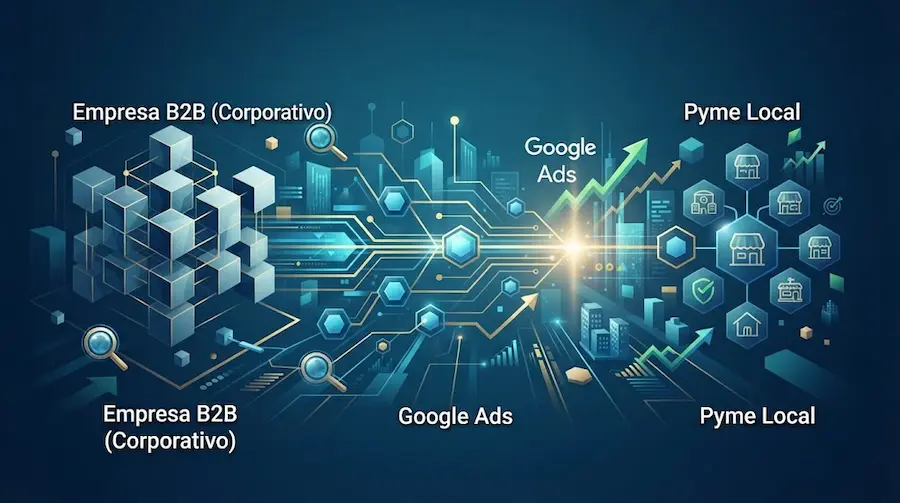
Revenue impact is especially powerful when automation sits downstream of paid acquisition. If you are already investing in Google Ads for high-ticket B2B services, every lead that falls through the cracks is wasted ad spend. Automation that captures, qualifies, and nurtures those leads improves the return on your media budget, not just your operations.
Isolating Automation’s Contribution
To credit revenue fairly, use one of three methods: a before/after comparison over matched periods (adjusting for seasonality), a controlled split where only part of your pipeline runs through the automation, or funnel-stage attribution that measures conversion rates at the exact stage the agent touches. The controlled split is the most rigorous and the one we recommend whenever volume allows.
Layer 4: Strategic Value
Strategic value is the hardest to quantify, but often the most important over a multi-year horizon. It includes:
- Scalability: The ability to grow into new markets without proportional cost increases
- Data assets: Clean, structured data generated by automated processes that improves future decisions
- Resilience: Reduced dependence on specific individuals for critical processes
- Competitive speed: Faster quotes, faster onboarding, faster service than competitors
You may not put a precise dollar figure on strategic value, but you should document it. It is often the reason an engagement that looks break-even in year one becomes highly profitable in year two.

Calculating Total Cost of Ownership (TCO)
Quick answer: Total cost of ownership for AI automation includes agency fees, platform and API usage, internal staff time for onboarding and review, data preparation, ongoing maintenance, and change management. Ignoring internal costs is the most common reason ROI projections miss reality.
The «cost» side of the ROI equation deserves just as much scrutiny as the «gain» side. A realistic TCO includes both visible and hidden costs.
Visible Costs
- Agency fees: Build fees, retainers, or performance-based arrangements
- Platform costs: Automation platforms, LLM API usage, hosting, and third-party integrations
- Licensing: Any new software required to support the automation
If your engagement runs on a monthly retainer, it pays to understand exactly what that retainer covers. Our guide on how to evaluate an agency retainer breaks down the questions to ask before you sign, and they apply directly to automation partnerships.
Hidden Costs
These are the costs that quietly erode ROI when no one tracks them:
- Internal time: Hours your team spends in discovery, testing, feedback sessions, and approvals
- Data cleanup: Automations are only as good as the data they run on; messy CRMs require preparation
- Human-in-the-loop review: Staff time spent checking or correcting AI outputs, especially early on
- Maintenance: Updating workflows when APIs change, processes evolve, or models are upgraded
- Change management: Training, documentation, and the productivity dip during transition
The Build vs. Buy Question
Some companies weigh building automation in-house against hiring an agency. When you factor in recruiting, salaries, tooling, and the learning curve of a new internal team, the agency route often wins on TCO, especially in the first 12–18 months. We explore this trade-off in depth in our article on why B2B companies in the US are outsourcing AI agent development.

A Practical ROI Framework You Can Use Today
Quick answer: Measure AI automation ROI in five steps: set a pre-engagement baseline, define outcome KPIs per workflow, track full TCO, measure at 30, 90, and 180 days, and calculate a blended ROI across all four value layers. Review quarterly and cut or expand workflows based on results.
Here is the process we recommend for any AI automation engagement, whether you work with us or another partner.
Establish a Baseline Before Anything Is Built
You cannot measure improvement without a starting point. Before the agency writes a single workflow, document current performance for every process in scope: time per task, volume, error rates, response times, conversion rates, and cost per outcome. An agency that does not ask for baseline data is an agency that does not plan to be measured.
Define Outcome KPIs for Every Workflow
Each automation should have one primary KPI and one or two secondary KPIs. For example:
| Automation | Primary KPI | Secondary KPIs |
|---|---|---|
| Inbound lead response agent | Lead-to-meeting rate | Response time, cost per meeting |
| Invoice processing | Processing cost per invoice | Error rate, days to payment |
| Customer support triage | First-contact resolution | Ticket volume per agent, CSAT |
| Proposal generation | Time from request to proposal | Close rate on proposals |
Measure on a Realistic Timeline
AI automation follows a curve. Expect this pattern:
- Days 1–30 (Stabilization): Bugs, edge cases, and adjustments. ROI is often negative.
- Days 31–90 (Adoption): Usage grows, review rates drop, early savings appear.
- Days 91–180 (Optimization): The agency refines prompts, logic, and integrations. Revenue effects become measurable.
- Months 6–24 (Compounding): New workflows build on existing infrastructure at lower marginal cost.
Judging an engagement at day 30 is like judging a new sales hire after their first week. Patience, paired with rigorous tracking, is the winning combination.
Step 4: Calculate Blended ROI
Combine the layers into a single view:
True ROI = (Direct Savings + Capacity Value + Attributed Revenue Gain – Total Cost of Ownership) ÷ Total Cost of Ownership
Track strategic value alongside this figure as a qualitative scorecard. Together, the two give leadership an honest picture of both current returns and future potential.
A Simple Illustrative Example
Imagine a B2B services firm that deploys an AI lead-qualification agent. The agent eliminates most of the manual screening work previously done by two coordinators, freeing them to handle client onboarding instead of hiring an additional onboarding specialist. Meanwhile, faster response times lift the share of inbound leads that book a discovery call. In this scenario, the firm captures value in three layers at once: direct savings from reduced screening time, capacity value from an avoided hire, and revenue gain from more booked calls. Measured on savings alone, the engagement might look modest. Measured across all layers, it can be one of the highest-return investments in the business.
Review Quarterly and Reallocate
Not every automation will perform. The best engagements treat workflows like a portfolio: double down on the winners, fix the underperformers, and retire what does not work. A quarterly business review with your agency should cover every KPI against baseline, not just a list of completed tasks.

Red Flags That Signal Weak ROI From an Automation Agency
Quick answer: Warning signs include agencies that report only activity metrics, skip baseline measurement, avoid outcome-based KPIs, lock you into proprietary systems without documentation, or cannot explain how each automation connects to revenue or cost reduction.
Watch for these patterns in any engagement:
- Vanity reporting: Dashboards full of «tasks automated» and «messages sent,» with no link to business outcomes
- No baseline: The agency started building without documenting your starting point
- Black-box builds: No documentation, no access to logic, and no path to ownership if you part ways
- Isolated automations: Workflows that do not connect to your CRM, ad platforms, or reporting stack
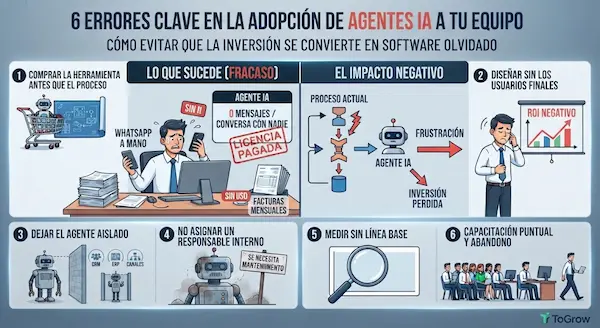
- One-and-done mindset: No plan for optimization after launch
The last point matters more than most people realize. Automation delivers its highest returns when it is part of a connected growth system rather than a standalone project. That is the same logic behind the full-service Marketing 360 model versus traditional digital agencies: when acquisition, conversion, and operations share data and strategy, every piece performs better.
What a High-ROI Partner Looks Like
The strongest automation partners share a few traits. They start with discovery and baseline data. They tie every build to a business KPI. They document everything so you own the logic. They report outcomes monthly. And they think in terms of assets that appreciate over time, much like the principle behind custom software development that drives recurring ROI. Well-built automation is not an expense you repeat; it is infrastructure you keep benefiting from.
Frequently Asked Questions

How long does it take to see ROI from an AI automation agency?
Most businesses see early, measurable savings within 60 to 90 days, once the automation has stabilized and staff adoption has grown. Revenue-related gains typically become clear between three and six months. The full return, including compounding strategic value, usually emerges over 12 to 24 months as additional workflows are layered onto the initial infrastructure.
What KPIs should we track to measure AI automation ROI?
Track a mix of efficiency and growth metrics. On the efficiency side, measure time per task, cost per process, error rates, and human review rates. On the growth side, measure lead response time, lead-to-meeting conversion, close rates, revenue per employee, and customer retention. Every automation should have one primary KPI tied directly to a business outcome.
Is it better to build AI automation in-house or hire an agency?
It depends on your scale, timeline, and internal expertise. For most mid-sized B2B companies, an experienced agency delivers faster time to value and lower total cost of ownership in the first 12 to 18 months, since you avoid recruiting, training, and the trial-and-error phase. Companies with large, specialized engineering teams may eventually bring some work in-house, often after an agency has established the foundation.
Conclusion

The true ROI of an AI automation agency engagement is rarely visible in a single number or a first-month report. It lives across four layers: direct savings, capacity gains, revenue impact, and strategic value. It only becomes clear when you establish a baseline, track total cost of ownership honestly, and measure outcomes on a realistic timeline.
Companies that measure this way make better decisions. They keep the automations that compound, fix the ones that stall, and hold their partners accountable for business results rather than activity.
join us on social media to stay up to date with our latest news, events, and exclusive promotions. Don’t miss out — follow our accounts today!

- Service Page Refresh: Stated Pricing Floor & Confirmed Google Partner Tier Updates - septiembre 22, 2026
- How to Measure the True ROI of an AI Automation Agency Engagement - septiembre 22, 2026
- How to Evaluate $3K+ Agency Retainer Agreements - septiembre 21, 2026